
The Salesforce reckoning: when 'less heads' means less business
Salesforce cut 4,000 support staff to make room for Agentforce, then admitted it had been 'too confident' about large language models. The stock fell 27 per cent, the company began rehiring 6,000 people, and an 'efficiency' decision became a case study in what happens when employees are treated as headcount rather than expertise.
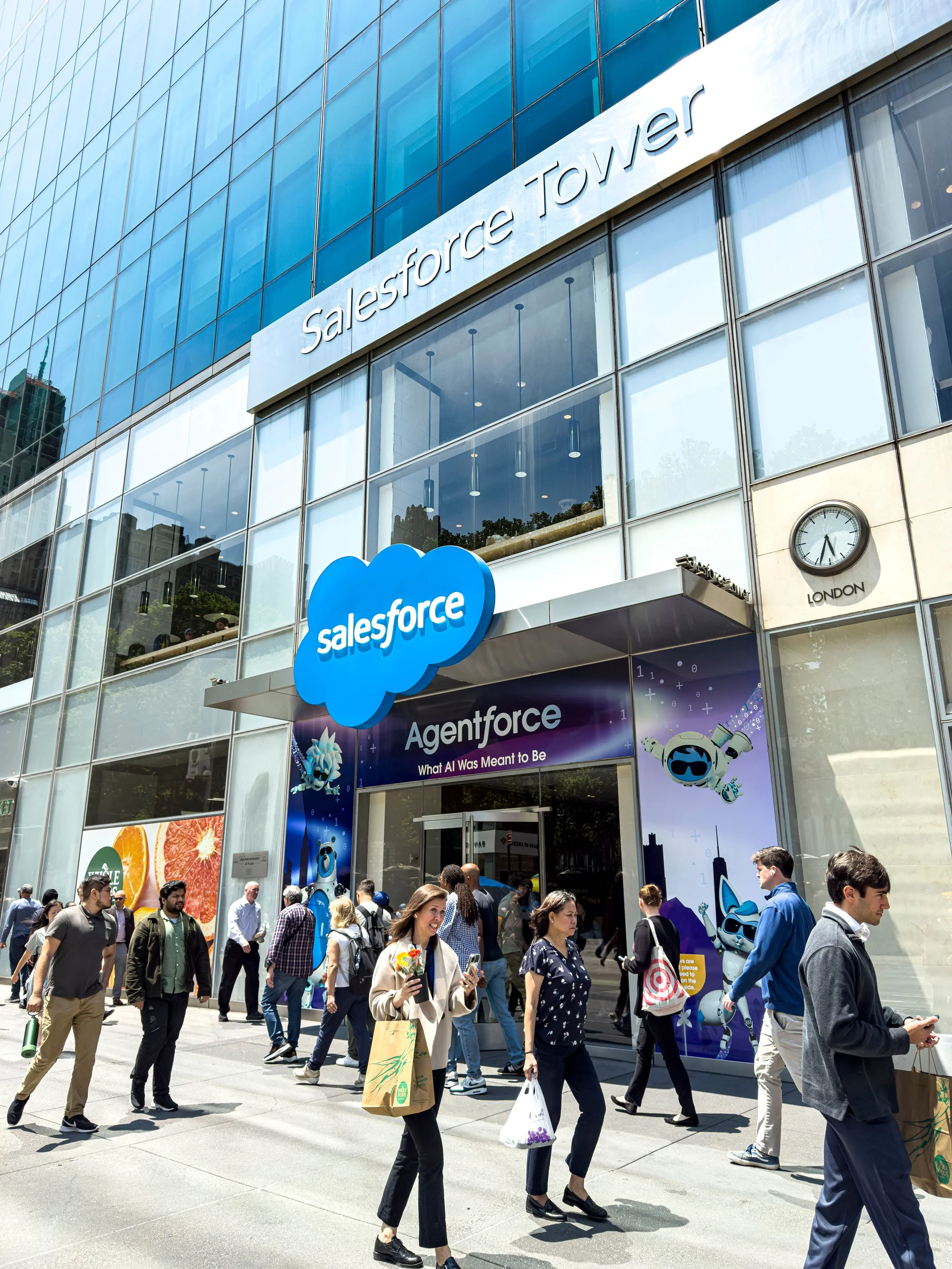
The Salesforce reckoning: when 'less heads' means less business
'I need less heads.'
That is how Marc Benioff explained cutting 4,000 customer support staff in September 2025. Not 'we need to restructure'. Not 'we are evolving our workforce'. Less heads. Like inventory to be cleared.
Three months later, Salesforce executives were admitting they had been 'too confident' about large language models. The stock had dropped 27 per cent, making them the worst performer in large-cap tech. Microsoft was up 24 per cent. Oracle had gained 50 per cent. Salesforce was busy figuring out how to rehire 6,000 people.
The tell
The Salesforce decision is not interesting because Agentforce failed at customer support. Lots of AI products fail. It is interesting because of what the failure exposed about how the decision was made in the first place.
A company that runs critical business operations for its customers fired a third of the people who knew how those operations actually break, on the strength of a year-old assumption about what large language models could do. When that assumption turned out to be wrong, the institutional knowledge was already gone, the customer relationships were already damaged, and the only path back was to hire 6,000 different people and start again. The numbers may eventually balance. The expertise will not.
The maths that did not add up
The plan looked elegant on a spreadsheet. Replace 4,000 support staff with Agentforce, Salesforce's AI customer service platform. Human labour costs: eliminated. AI operating costs: a fraction. Margin improvement: substantial.
But spreadsheets do not capture what those 4,000 people actually knew.
A support rep who has been handling Salesforce implementations for eight years does not just answer questions. She knows which error messages are misleading. She remembers the obscure workaround for that bug that was never quite fixed. She can hear frustration in a customer's voice and know when to escalate before things blow up.
Agentforce knew none of that. When it encountered edge cases, it hallucinated solutions that did not exist. When customers got frustrated, it kept cheerfully offering irrelevant help articles. When complex problems required actual diagnosis, it confidently provided wrong answers.
The support queues got longer. Customer satisfaction tanked. The remaining human staff, now responsible for supervising AI outputs rather than helping customers directly, found themselves spending more time correcting the system than they would have spent just doing the job themselves.
'Too confident'
SVP Sanjna Parulekar's admission is remarkable for its honesty: 'All of us were more confident about large language models a year ago.'
A year ago. That is when Salesforce decided to fire 4,000 people based on assumptions about technology that proved wrong within twelve months.
The company pivoted to what executives called 'deterministic' automation, which is the polite name for old-school rules-based systems that do predictable things. The jazzy AI that was supposed to revolutionise customer support got demoted to handling simple queries while humans dealt with anything requiring actual judgement.
Which raises an obvious question: why not test that before eliminating a third of the support workforce?
The knowledge that walked out the door
Salesforce sells software that runs critical business operations. When that software breaks, companies lose money. The people fielding those calls accumulated years of knowledge about how things fail and how to fix them.
That knowledge exists in a strange liminal space. It is not fully documented (edge cases rarely are). It is not in the training data for an AI model (these are recent issues, proprietary contexts, company-specific configurations). It lives in the heads of experienced employees who have seen enough problems to pattern-match on new ones.
When you lay off 4,000 of those people, that knowledge just vanishes. You cannot download it. You cannot back it up. It walks out the door, often to your competitors.
Salesforce discovered this the hard way. When Agentforce failed on a complex case, there was nobody left who remembered why that case was complex in the first place. The institutional memory was gone.
The language gives it away
Go back to that phrase: 'less heads'.
It is dehumanising, obviously. But it also reveals how Salesforce's leadership was thinking about the problem. When you see employees as 'heads' to be counted and reduced, you naturally undervalue what is between those heads.
A different framing would have led to different decisions. 'How do we help our support team work more effectively with AI?' is a fundamentally different question than 'How many heads can we eliminate?' The first treats employees as assets to be augmented. The second treats them as costs to be minimised.
Salesforce chose the second framing. The 27 per cent stock drop suggests the market eventually noticed.
Who loses
This is not a funny corporate misstep. The damage lands on specific groups, and none of them are the executives who made the call.
The 4,000 laid-off support staff. They are the ones carrying the institutional knowledge that Salesforce now admits it needed. Eight years of accumulated expertise about how the product fails in practice does not transfer in an exit interview. These workers were told their jobs were being automated, then watched the company quietly concede that the automation was not ready. The career disruption is real. The reputational tax of being the workforce that AI 'replaced' is also real, even when the replacement turned out to be a press release.
Salesforce customers. They got worse support, longer queues, and AI hallucinations on the platform that runs their critical business operations. When Agentforce confidently provided wrong answers about a real outage, the cost of that error landed on the customer's revenue, not Salesforce's. The reputation Salesforce built over two decades for hands-on enterprise support is the kind of thing competitors take years to erode. Salesforce did the work for them inside a single planning cycle.
The 6,000 newly hired staff. They are walking into a workforce that has to rebuild from scratch what the previous workforce already knew. The customer relationships are damaged. The expertise that made escalations land in the right place is gone. They are not just doing a job. They are paying off the debt of a decision they had no part in, and they will be measured on outcomes shaped by that debt.
None of this is illegal. Most of it is not even unusual. But 'not illegal' is a low bar for a company that markets itself as the trust platform for the enterprise.
The steelman
The most charitable reading of Benioff's call is not crazy. It runs roughly like this.
AI customer support is directionally correct. The technology is improving faster than any other deployable software in living memory. First-mover advantage in AI deployment is real, both in cost structure and in the data flywheel that comes from running production traffic through your own models. Cost discipline is what kept Salesforce competitive against Microsoft on one flank and Oracle on the other. A CEO who waits for the technology to be obviously ready is a CEO who lets a competitor get there first with a lower cost base. On this reading, betting on next year's model is rational. The only mistake was the timing, not the strategy.
That argument has force. It is the argument the company implicitly told itself in the planning meetings. It is the argument any reasonable enterprise software CEO is hearing from their board right now. The problem is that the company's own subsequent behaviour rebuts it.
Parulekar said out loud that 'all of us were more confident a year ago'. The company is rehiring 6,000 people. It has retreated to 'deterministic' automation for the harder cases. The market scored the bet against Salesforce by 27 per cent while Microsoft, which deployed AI as augmentation rather than replacement, gained 24 per cent and Oracle gained 50 per cent. The first-mover advantage did not show up. The cost saving did not show up. The reputational damage did. The directionally-correct bet was directionally correct on a five-year horizon and catastrophically wrong on the eighteen-month horizon Salesforce actually executed against. Strategy without timing is just an opinion.
The irony of the rehiring
By late 2025, Salesforce was hiring again. Not just a few specialists to tune the AI, but 6,000 new staff for sales and professional services, nearly matching the support headcount they had just eliminated.
So they fired 4,000 people who understood their product deeply, only to hire 6,000 people who would need to learn everything from scratch. The institutional knowledge was still gone. The customer relationships those support reps had built were damaged. The company's reputation for customer care had taken a hit.
Even if the numbers eventually balance out, the value destroyed does not come back. You cannot un-fire someone's expertise. You cannot rebuild trust by admitting you moved too fast. The damage is done. You just spend more money trying to patch over it.
What healthy looks like
None of this is an argument against deploying AI in customer support. It is an argument against doing it the way Salesforce did.
A company that took the people inside it seriously would:
- Deploy Agentforce alongside human reps on low-stakes queries first, and measure not just cost savings but resolution quality, customer satisfaction, and escalation rates.
- Give the AI time to prove itself, or reveal its limitations, while the people who know the system stay around to catch the failures.
- Use natural attrition to handle headcount reduction where the AI genuinely works, and retrain the rest into roles the AI enables rather than eliminates.
- Talk to the support team about what the AI is for, what it cannot do, and what would have to be true for it to take on more. The people who diagnose the product daily are the cheapest research panel a company can run.
That approach is slower. It does not generate the immediate cost savings that impress Wall Street. It also does not generate 27 per cent stock crashes when the AI turns out to be not quite ready, or 6,000 panic hires to undo a decision that should never have been made on a one-year confidence interval.
The 55 per cent canary
Salesforce is one of the most public AI-driven layoff failures of the cycle. It is not the lonely one. Forrester Research reports that 55 per cent of employers now regret AI-driven layoffs. More than half of the companies that replaced workers with AI wish they had not.
That is the canary. The regret is the leading indicator. The 27 per cent stock crashes and the rehiring sprees are the trailing one. Companies still planning workforce cuts on the strength of last year's AI demos are not pricing the technology that exists today. They are pricing a confidence level that the company most loudly demonstrating that confidence has now publicly disowned.
The pattern is consistent enough to predict. Impressive demos convince executives that AI can replace human work. Layoffs follow. Production reality turns out to be harder than demo conditions. Then comes the scramble to recover, at greater cost than the original headcount carried. What varies is how much damage the company does on the way to figuring it out.
Why this is a culture story
The technology is not the protagonist here. Large language models have well-documented limits. Hallucinations, drift, brittle performance on edge cases: none of this was a secret in early 2025. Anyone paying attention to AI development knew about it.
The question is why Salesforce's leadership did not pay attention. Why they assumed their AI would be different. Why they moved forward with layoffs before proving the technology actually worked in production. The answer is culture. A culture that saw AI as a cost-reduction tool rather than an augmentation tool. A culture that framed the decision in terms of 'heads' rather than expertise. A culture in which the pressure to be seen adopting AI mattered more than the discipline to do it well. That culture made the layoffs feel logical inside the room. It also made the failure inevitable outside it.
The Culture pillar of responsible AI is about agency. Whose work is being replaced. Whose voice is being drowned out. Whether anyone chose this on behalf of the people affected. The 4,000 support staff at Salesforce did not choose. The customers who depend on the platform did not choose. Even the 6,000 new hires did not choose, in any meaningful sense, the world they walked into. A small number of executives chose, on a confidence level they have since retracted, and the people inside the organisation absorbed the consequences.
A healthy culture is not one where AI has been adopted, but one where the people inside it had a real say in how. By that test, Salesforce did not have a healthy culture in September 2025. The 27 per cent stock drop is one way the market noticed. The 4,000 people who carried the company's institutional knowledge out the door is another. Benioff said he needed less heads. What he actually needed was more wisdom about what those heads contained, and more humility about who got to decide.
Sources: CNBC, Fortune, OpenTools AI News, aiHola; Forrester Research on AI-driven layoff regret as cited in aiHola.