
The Duolingo downfall: when 'AI-first' means users last
Duolingo cut its human linguists, told the AI to ship, and watched its stock fall 25 per cent as paying learners noticed the lessons had quietly degraded. The pivot is a small story. The governance failure underneath it, an AI rollout with no one accountable for whether it worked, is the part worth reading.
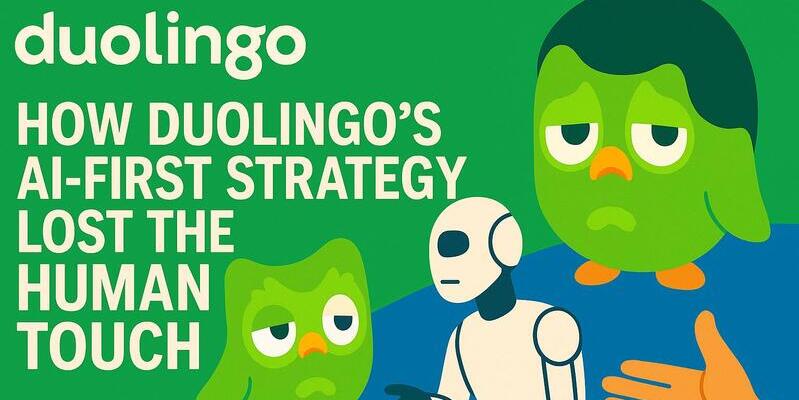
The Duolingo downfall: when 'AI-first' means users last
The internal directive was blunt. Duolingo staff were told to "take occasional small hits on quality" rather than "move slowly and miss the moment". By late 2025, the language-learning app's stock had fallen roughly 25 per cent. Users were leaving. CEO Luis von Ahn went public to say he "did not expect the amount of blowback".
The cause was not a market downturn or a new competitor. It was a choice: swap human linguists for generative AI, ship faster, save on payroll, hope nobody noticed the lessons had got worse.
People noticed.
The tell
The interesting thing about the Duolingo decline is not that an AI rollout went badly. It is the shape of the failure. The company did not get ambushed by a model that hallucinated in some unforeseeable way. Leadership wrote down, in advance, that small hits on quality were acceptable. They shipped. The hits were not small. The stock reflected it.
What that sequence reveals is not a technology problem. It is a governance vacuum. Nobody in the room had the authority, or the incentive, to stop a degradation that had been authorised at the top.
The pivot, and the bet underneath it
Duolingo's leadership made a clean bet on generative AI. Reduce the human linguists. Let models handle translations and lesson generation. Ship more content in more languages. Move the savings to margin.
The execution did not match the deck. Learners hit wrong translations that taught them incorrect vocabulary. Lessons looped, the algorithmic equivalent of a scratched record. Premium subscribers, paying the same monthly fee they had always paid, were now receiving instruction the company itself had pre-classified as lower quality.
Von Ahn later said he "did not expect the amount of blowback". The strategy did not change. The AI-first commitment held. That continuity, in the face of a 25 per cent stock fall and visible user departure, is the bit that matters. Reversing course would have required someone to own the decision to reverse. No such person existed.
The pattern
Duolingo is not the first company to write down "occasional small hits on quality" as an acceptable cost of speed.
In 2022 and 2023, several US news publishers (CNET and Sports Illustrated among them) quietly replaced staff writing with AI-generated content under human bylines. The errors surfaced. The bylines turned out to be fictional. Trust took the loss, not the executives who approved it.
The longer parallel is the offshoring wave of the early 2000s. Customer support, then engineering, then content moderation were moved to lower-cost vendors on the same logic Duolingo used: a tolerable drop in quality in exchange for a permanent drop in cost. The drops were not always tolerable, and almost never reversed by the people who authorised them, because by then those people had moved on or moved up.
The rebrand changes. The mechanic does not. A senior decision to accept degraded output is taken without the people who will have to live with the degradation in the room, and without a return loop that pulls the consequences back to the desk that signed off.
The mechanic behind the gap
There is a specific question Duolingo's structure apparently never had to answer: who owns translation quality?
Not in the abstract sense of company values. In the practical sense of whose performance review, bonus, or job depends on whether a learner ends a lesson knowing more Spanish than they did at the start. While human linguists were in the loop, the answer was clear enough. They were paid to catch errors and they did. Once the AI took over content generation, the role disappeared and the accountability disappeared with it. The metrics that survived (engagement, retention, conversion to premium) measured whether people opened the app, not whether they learned a language.
This is the standard shape of an AI governance failure. The technology replaces a human function. The performance contract attached to that human function is not replaced. There is nothing in the org chart that breaks if quality drops, because quality was never anyone's number to defend.
A working governance framework would have asked the question before the transition, not after the share price fell. What quality bar must the AI clear before it replaces the linguists? How will we measure whether it is slipping after deployment? Who has the authority to halt the rollout if the answer is "yes, it is slipping", and what does that person stand to lose by exercising that authority?
Duolingo's apparent answer to all three was a shrug. The assumption seemed to be that AI adoption was inevitable, the savings were real, and the question of who held the brake handle could be deferred. The 25 per cent fall is what deferral looks like when it lands.
Who loses
Four groups absorbed the cost of this decision. None of them were in the room when it was made.
Paying premium subscribers. Duolingo continued to charge its premium tier the same price after the transition. The product those subscribers were paying for was, by leadership's own internal language, taking "small hits on quality". That is a unilateral price increase dressed up as a feature change. Premium subscribers paid more per unit of working instruction without being told the unit had shrunk.
Learners with real-world stakes. A casual user practising Italian for a holiday can shrug off a wrong translation. A learner using Duolingo to prepare for a job interview, a citizenship test, or a conversation with a partner's family cannot. Those learners trusted that "ready for your interview in Spanish" meant the Spanish was correct. When it was not, the cost did not land on Duolingo. It landed on whoever turned up to the interview with a memorised wrong word.
The human linguists and translators whose roles were eliminated. This group is the easiest to forget because they exited the company before the consequences arrived. They were also the only group inside Duolingo whose job description included catching the kind of errors that drove the stock down. Their removal was treated as a cost line. It was also a removal of the company's primary quality-assurance mechanism, and it was approved without anyone naming it as such.
Shareholders. The 25 per cent fall is the only loss that Duolingo's leadership could not look past. It is also the loss with the loudest feedback loop. The other three groups had to wait for the market to notice on their behalf. That is what an absent governance structure does: it converts harms to users into a financial signal, eventually, and only then forces the conversation that should have happened first.
The steelman
The strongest version of the AI-first defence is not stupid, and it is worth stating clearly before dismissing it.
Generative AI translation does scale in ways human linguists cannot. A model that reaches a tolerable quality bar in one language can be pointed at fifty more for marginal cost. The savings, if they were redirected to expansion, could in principle take Duolingo into under-served languages and learners that were never economic to staff manually. "Take occasional small hits on quality" was not, on this reading, negligence. It was an explicit, calculated trade-off: short-term degradation in exchange for a structurally cheaper and broader product. Move fast, accept some breakage, fix as you go. That is how every other category of consumer software has been built for the last twenty years.
The reading is coherent. It is also wrong on this product, for three reasons rooted in what actually happened.
First, education is not a category where "occasional small hits on quality" reads as an acceptable trade-off. A wrong vocabulary item is not an inconvenience that gets smoothed out in the next release. It is a thing the learner now believes, and will say in front of an interviewer, an immigration officer, or their partner's parents. The cost compounds outside the product, where Duolingo cannot see it and cannot fix it.
Second, the savings did not flow to expansion. They flowed to margin. There is no public record of the AI transition funding under-served languages or cheaper access for learners in lower-income markets. The premium price held. The free tier did not improve. The trade-off the steelman defends, cheaper now, broader later, did not occur.
Third, the AI did not actually clear the quality bar that the existing customers were paying for. "Move fast and break things" assumes the things you break are tolerable. When the broken thing is the core competency you are charging a subscription for, the strategy does not work, regardless of what the rest of consumer software does.
What healthy looks like
A governable version of the same transition is not hard to describe.
- Establish the quality bar, in measurable terms (translation accuracy, lesson outcome data, error rates by language pair) before any human linguists are released, not after.
- Name a single accountable owner for that bar who sits outside the engineering organisation and whose performance review is tied to learner outcomes, not ship velocity.
- Run AI-generated content alongside human review for a defined period, with the threshold for full rollout written down and gated on the metrics above.
- Disclose the change to paying subscribers. If the product is materially different, the price conversation is honest, not silent.
- Build an explicit halt mechanism. The accountable owner has the authority to roll back the transition if the bar is not met, and that authority is real (their bonus does not depend on the rollout succeeding).
None of this is bureaucratic overhead. It is the basic shape of risk management for a company whose entire value proposition is teaching people effectively.
The canary
Duolingo is small enough to fail visibly. Its product is consumer software with a public app store, a public stock ticker, and an audience of learners loud enough to register their complaints in the share price within a quarter. The feedback loop, by the standards of these things, is fast and legible.
The same governance vacuum, transplanted into a regulated industry where failures are slower to surface, is the part worth being scared of. AI-first pivots are now under way in healthcare triage, financial advice, legal drafting, and primary education. The internal logic is identical: cut the expensive human reviewers, accept "occasional small hits on quality", route the savings to margin, defer the question of who owns the quality bar.
In healthcare, the wrong answer does not produce a 25 per cent stock fall. It produces a missed diagnosis, months later, in a patient who never knew the model was in the loop. In finance, it produces an advice trail nobody can audit because the human who would have signed it no longer exists. In education at school level, it produces a cohort of learners who do not yet know what they were not taught.
Duolingo is the cheap version of this story. It cost shareholders a quarter and learners a few wrong words. The expensive versions are coming, and the people who would have to halt them are, in the same way, not yet in the room.
The governance pillar: who is holding the brake handle
Duolingo's collapse is not an AI story. It is a governance story with AI as the accelerant.
Every element of the failure has an analogue in older corporate disasters: a senior decision taken without the people who would bear the consequences in the room; a quality bar that was not anyone's job to defend; a CEO who was "surprised" because the warning system had been quietly dismantled along with the linguists; a strategy that could not be reversed because no single person had the authority to reverse it. The AI part changed the speed of the harm. It did not change the shape.
That is the bit worth taking from this case. The governance pillar of responsible AI is not about model cards, ethics statements, or review committees that meet quarterly. It is about whether, on the day the model starts producing bad output, there is a named person who can stop it, who has the authority to stop it, and who pays a price if they do not. If the answer to any of those three is no, the system is not governed. It is being run on hope.
AI systems without accountable decision-makers are not governable, no matter how well they perform. Duolingo's learners just wanted to learn Spanish. What they got, and what shareholders paid for, was a lesson in what happens when a company adopts a technology faster than it adopts the accountability to run it.
Sources: Duolingo internal communications and CEO Luis von Ahn public statements as reported in tech press, late 2025; Cory Doctorow on enshittification; Duolingo public stock data, 2025.